
Vendor rack-scale systems
Use the vendor's own component thermal interface and do not intervene. Warranty and support integrity are worth more than any achievable thermal gain.
How does heat leave a 2 kW package fast enough that the junction never throttles, at a coolant temperature warm enough that the building needs no chiller? Local heat flux across a modern accelerator package varies by roughly an order of magnitude, so a cold plate that distributes coolant uniformly over-cools most of the die to adequately cool a small part of it.
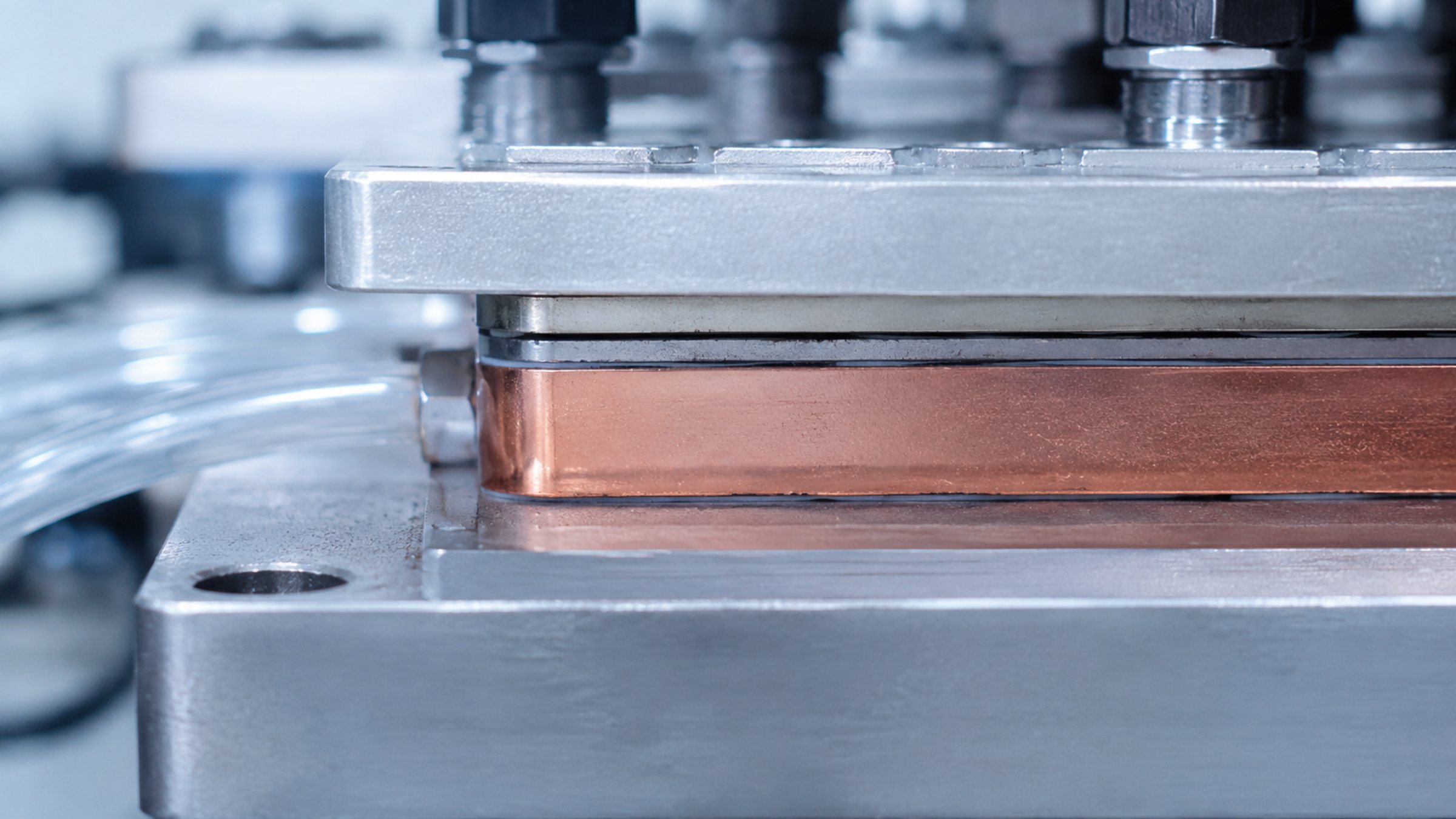
How does heat leave a 2 kW package fast enough that the junction never throttles, at a coolant temperature warm enough that the building needs no chiller?
Local heat flux across a modern accelerator package varies by roughly an order of magnitude. A cold plate that distributes coolant uniformly is, by definition, over-cooling most of the die in order to adequately cool a small part of it. The whole package then throttles to protect the hottest square millimetre.
Six capability categories: conventional microchannel cold plates; jet-impingement plates that break the thermal boundary layer at the hotspot; two-phase refrigerant evaporators that use latent heat rather than sensible heat; microfluidic geometries that deliver coolant per hotspot rather than uniformly; in-silicon microfluidics etched into the die backside; and passive spreader materials for the components a cold plate cannot reach.
Use the vendor's own component thermal interface and do not intervene. Warranty and support integrity are worth more than any achievable thermal gain.
Waterless two-phase evaporation at the die. A dielectric refrigerant leak does not short a board, which is the argument that matters in a hospital.
A Coral-designed cold plate geometry, generatively designed and produced by an additive manufacturing route capable of feature resolution finer than conventional machining. Coral owns the geometry. The manufacturer owns the process.
In-silicon microfluidics. Published hyperscaler testing has shown up to three times better heat removal than a conventional cold plate and a 65 percent reduction in peak silicon temperature rise. This is a roadmap item, not a shipping one.
The current shipping envelope holds maximum component temperature at 55 C against a maximum oil temperature of 45 C, a 10 C component-to-fluid margin at the design limit, with typical operation at 25-35 C oil. Coral publishes measured junction-to-coolant thermal resistance per architecture as the instrumented fleet grows.
The thermal interface material stack on the newest generation of AI silicon is not publicly settled, with credible published analyses disagreeing on whether the final design uses a liquid metal indium interface over gold-plated copper or a graphite interface. Nobody has published long-term compatibility data for either stack in dielectric immersion service. Coral considers this a first-order unanswered question for the entire immersion category.
A structured technical assessment of power, thermal capacity, density, jurisdiction and deployment sequencing for a specific site.