
Layer 3. Pod thermal environment
What removes the heat that never reaches a cold plate? In a modern compute tray a substantial fraction of total heat sits in voltage regulation, memory, network interfaces and power delivery, distributed across the board where a cold plate cannot economically reach.
The engineering question
What removes the heat that never reaches a cold plate?
Why this layer is harder than it looks
In a modern compute tray, a substantial fraction of total heat is not on the accelerator die. It is in voltage regulation, memory, network interfaces, retimers and power delivery, distributed across the board in places a cold plate cannot economically reach. In the previous accelerator generation this residual fraction was handled by air, at roughly 15 percent of tray heat load. That air path is what forces fans, dust ingress, acoustic noise and filtration into an otherwise liquid-cooled system.
What Coral evaluated
Single-phase dielectric baths with pumped circulation. Single-phase with natural convection. Two-phase pool boiling using fluorinated fluids. Two-phase using engineered non-fluorinated fluids with surface-enhanced boiling. Sealed chassis-level immersion with directed flow. And hybrid air paths using solid-state active cooling with no moving parts.
What Coral decided
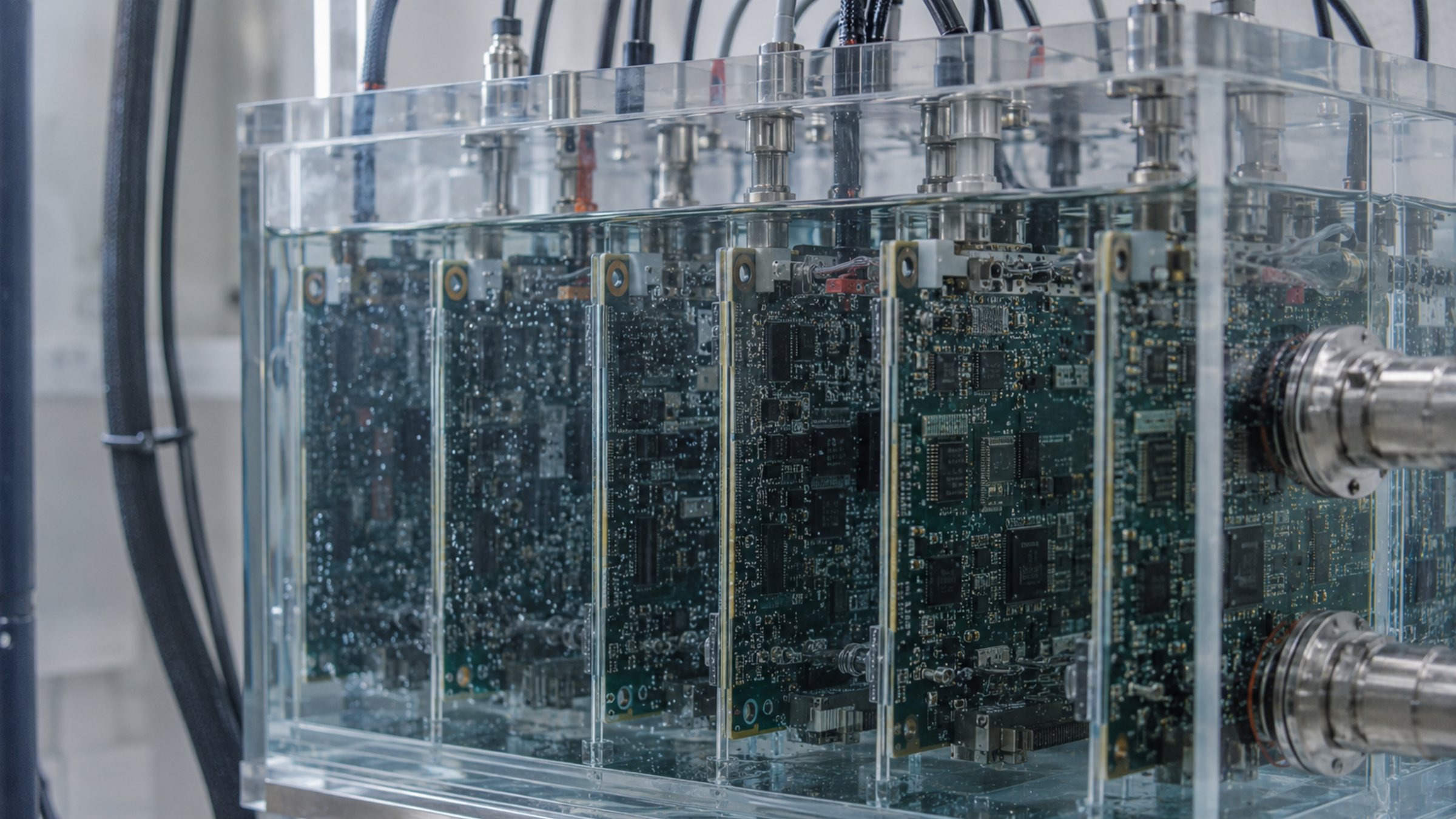
A dielectric environment handles board-level residual heat. This is the role immersion is genuinely best at, and Coral does not use it for anything else.
Fluid is qualified, never formulated. Coral does not make a dielectric fluid. It runs a qualification programme across bio-based natural esters, synthetic esters with established transformer-industry service life data, gas-to-liquid base stocks and engineered non-fluorinated two-phase fluids, and publishes the results.
No fluorinated fluid, in any Coral product, in any market.
For the Edge Series, sealed chassis-level immersion with directed flow, so that no service event ever involves open fluid handling.
Coral will not build a product on a fluorinated dielectric fluid. In December 2022 the dominant supplier of fluorinated engineered fluids announced it would exit that chemistry entirely, and in January 2023 a United States regulator designated certain per- and polyfluoroalkyl substances as hazardous. Several currently marketed replacements are themselves fluorinated and carry the same regulatory exposure. Coral's European, Canadian and Australian customers procure against lifecycle and disposal criteria, and a product built on a chemistry with an active regulatory trajectory is not a product Coral is willing to sell them.
The shipping position
The current fill is PAO or synthetic dielectric, in a design that is explicitly fluid agnostic. PAO is a synthetic hydrocarbon and contains no fluorinated chemistry, so the exclusion above is met by the shipping product today rather than as an aspiration.
What is still unsolved
Long-term ester oxidation and hydrolysis behaviour at the operating temperatures and thermal cycling profiles that AI workloads produce, which are materially more aggressive than the transformer service history the chemistry was characterised against.
Where this appears in the pod
Request an architecture review.
A structured technical assessment of power, thermal capacity, density, jurisdiction and deployment sequencing for a specific site.