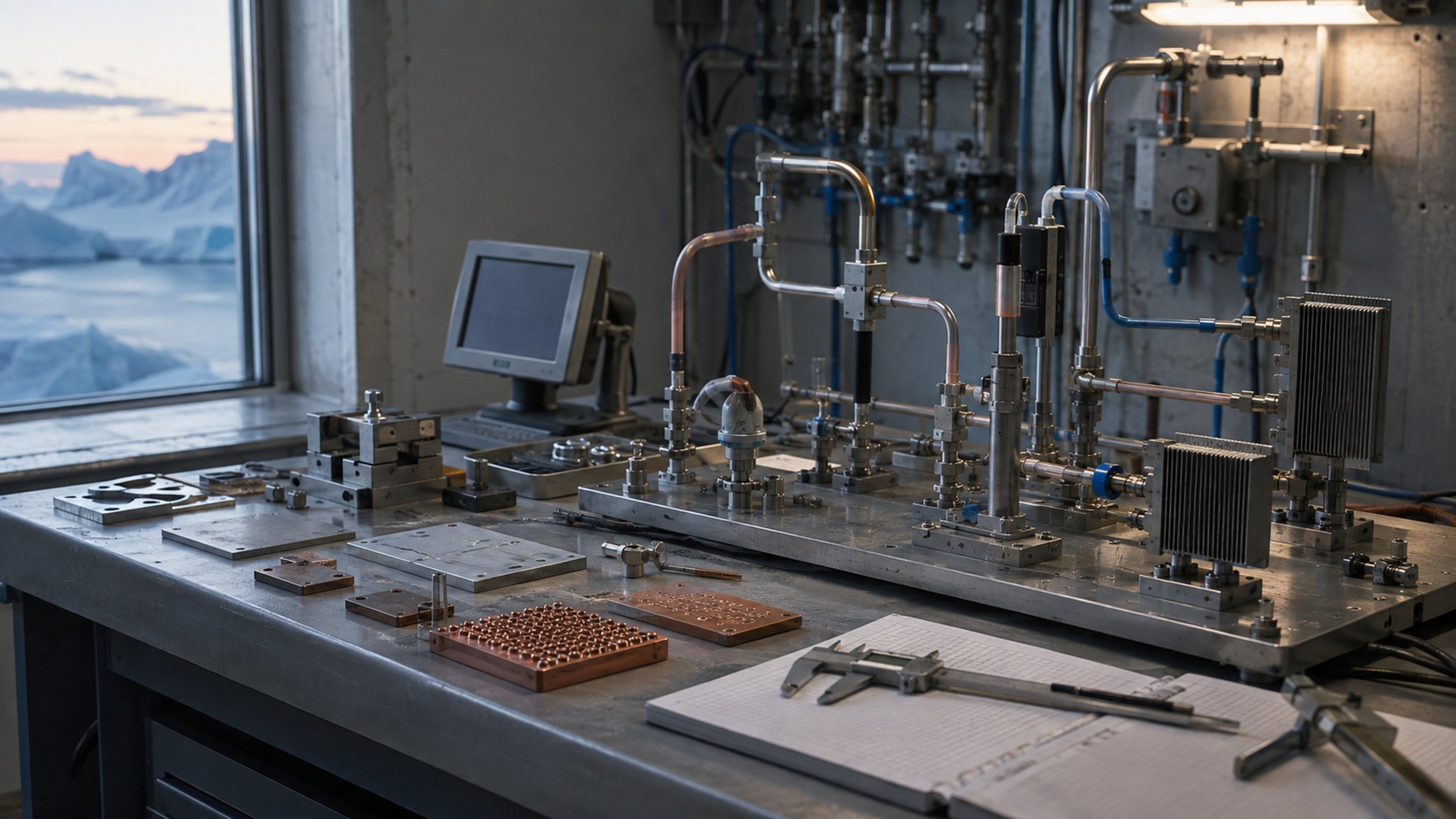
Thermal interface material compatibility in dielectric service
The newest AI silicon uses a metal thermal interface stack whose long-term behaviour in a hydrocarbon or ester bath has never been published. Gallium alloys attack aluminium and untreated copper. What happens over three years, and does the answer differ by fluid chemistry?
Why it matters: It is a latent risk under the entire immersion category, not just Coral's.
Co-packaged optics immersion compatibility
Can an optical engine, its fibre termination and its index matching survive dielectric immersion, and at what wavelength stability penalty?
Why it matters: As networking moves to co-packaged optics, this becomes a hard boundary on any immersion architecture.
Particulate generation in sealed dielectric loops
What is the actual particulate generation rate over multi-year service, and what drives it?
Why it matters: Filtration is currently specified on intuition.
Ester ageing under AI thermal cycling
Bio-based and synthetic esters are characterised against transformer service profiles. AI workloads cycle far harder. Does the service life projection hold?
Why it matters: It determines the total cost of ownership of the entire fluid decision.
Cold-climate viscosity and start-up
What is the correct fluid and circulation strategy for a pod cold-started at minus 30 C in a Canadian or Nordic winter?
Why it matters: Nobody publishes cold-start data, and Coral's home market has winters.
Thermal buffer sizing for contractible heat
What buffer capacity, as a function of workload volatility, makes a firm heat supply agreement bankable?
Why it matters: Heat offtake stays a marketing claim until this is solved.
Distributed fleet dispatch policy
How should a geographically dispersed fleet optimise jointly across differing tariffs, grid carbon intensity, workload mix, climate and heat offtake obligations?
Why it matters: Coral believes this is the most commercially valuable unsolved optimisation problem in the sector.
Spatial thermal field control
Given a continuous spatial thermal field rather than point measurements, what control policy actually exploits it? The measurement technology exists. The control theory for using it in this application does not.
Why it matters: It is the reason to instrument densely in the first place.