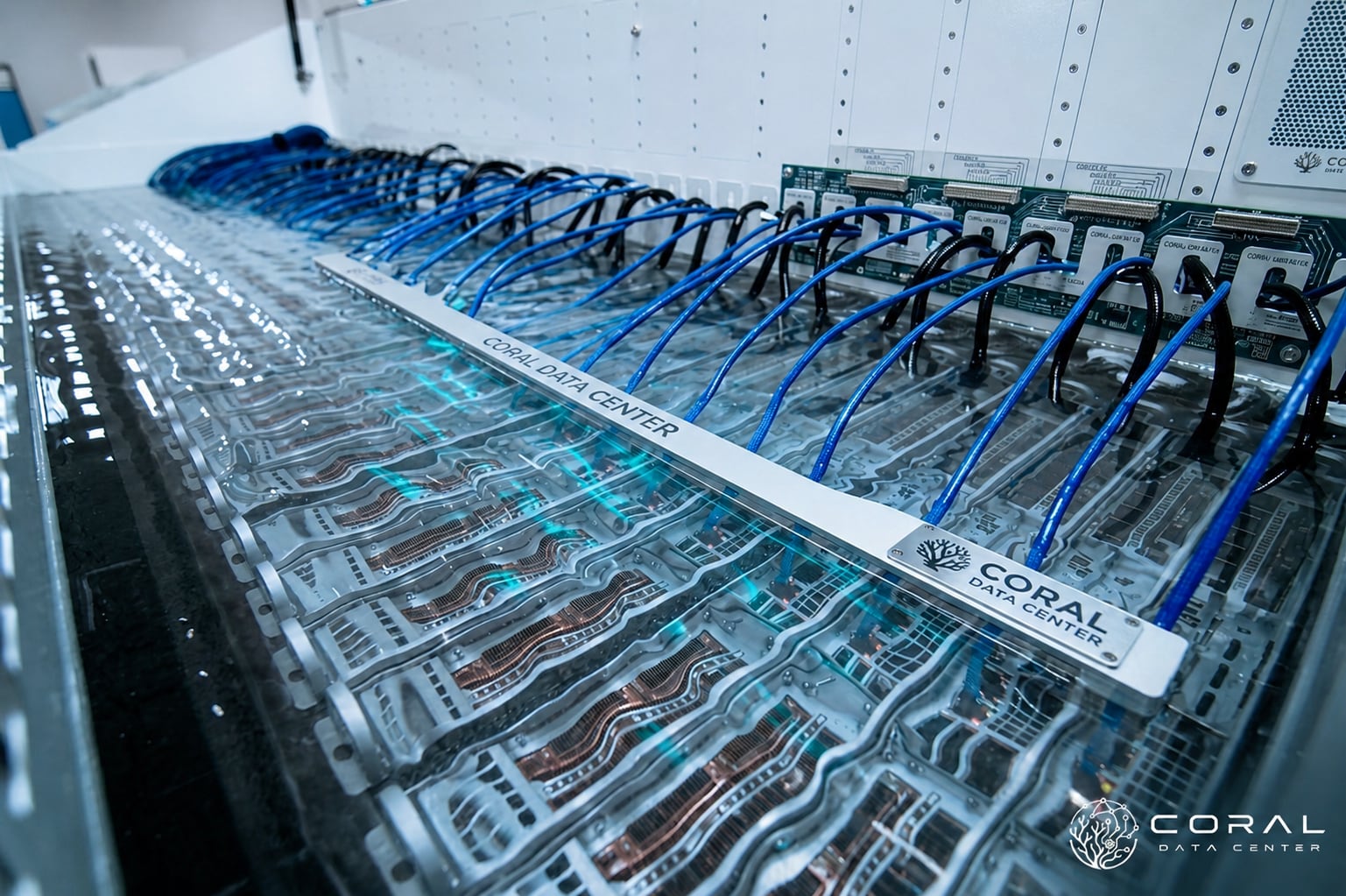
Current NVIDIA rack-scale AI systems, the generation after the hardware CoralDC's pods are built around today, ship one hundred percent liquid cooled at the compute tray, with microchannel cold plates fitted at manufacture and no air-cooled configuration offered. Coolant supply is specified up to 45 C, leaving the compute at approximately 55 C. NVIDIA has published no immersion reference architecture for this generation.
The practical consequence: on that next-generation rack-scale hardware, the cold plates are already there, bonded through a thermal interface stack onto the package. Removing that assembly to submerge a bare die is not an upgrade. It is a warranty question, an electrical safety case nobody has published for a busbar of that rating, and an unresolved compatibility question for co-packaged optical components, in exchange for no thermal benefit the fitted cold plates are not already delivering.
This is why CoralDC's next platform is hybrid, combining direct-to-chip liquid cooling for that class of hardware with immersion retained for PCIe and HGX class hardware, and for board-level and sealed-environment heat, where it remains the stronger answer. This is a direction under active engineering, not a current product, and this page says so rather than describing it as available today.
CoralDC states both of these things openly, the strength of immersion today and its limit on next-generation hardware, because a buyer who is told immersion is the universal answer, and later discovers otherwise, has been given a reason to distrust everything else they were told.