
The water number nobody puts on a datasheet
Coral's water position is not a sustainability initiative. It is an architectural consequence. Conventional evaporative data centre cooling consumes on the order of 2.6 million United States gallons of facility water per megawatt per year. Coral pods require no facility water connection in their dry rejection configuration, and that is an architectural consequence rather than an initiative.
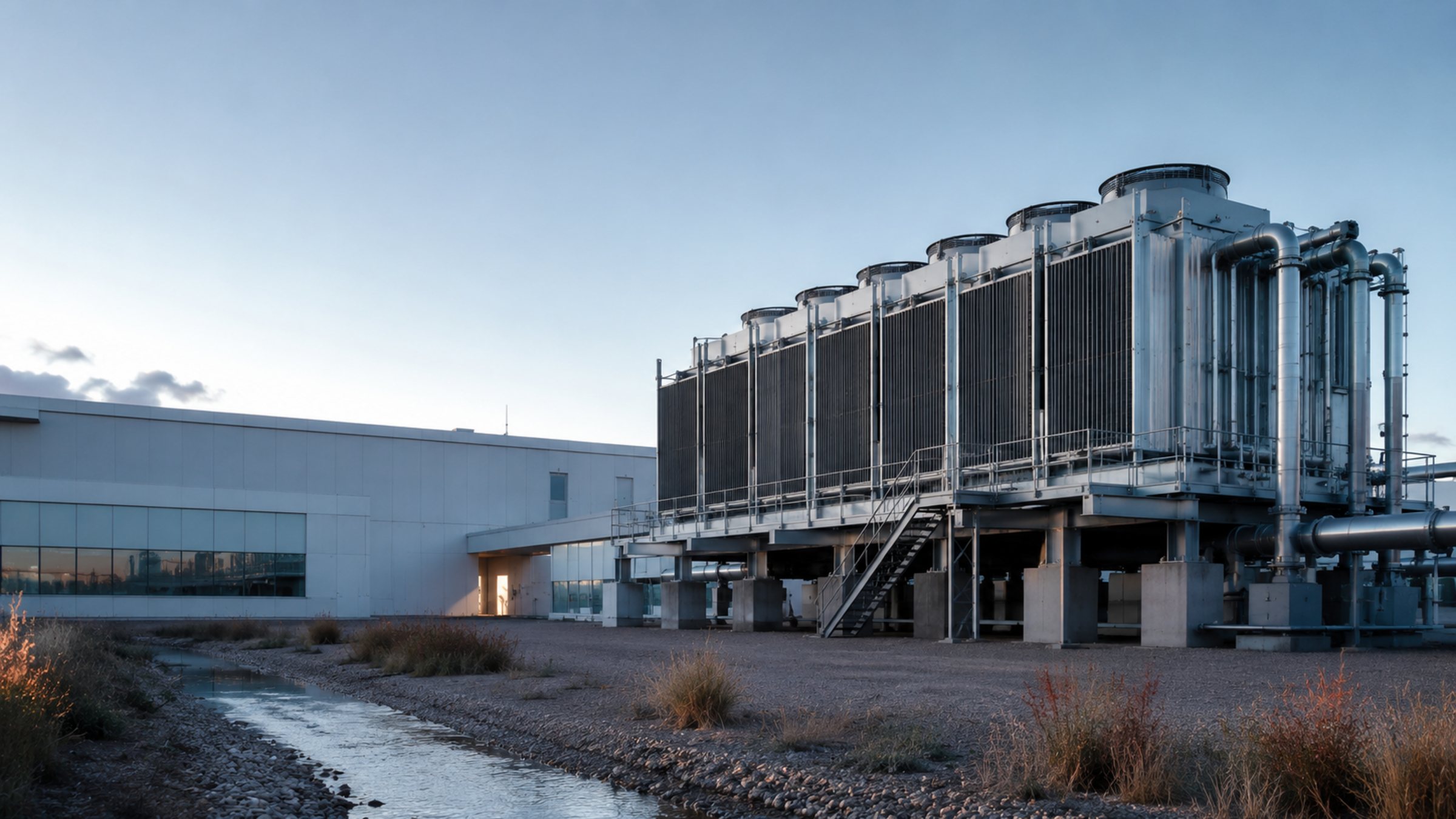
Conventional evaporative data centre cooling consumes on the order of 2.6 million United States gallons of facility water per megawatt per year. In a growing number of jurisdictions this is no longer a cost line. It is a licensing condition, and increasingly a reason planning permission is refused.
Why the water position follows from the loop temperature
Because Coral designs the secondary loop for a high supply temperature rather than a legacy chilled water temperature, heat can be rejected with dry coolers for the majority of operating hours in the majority of climates, and evaporative make-up water is not required.
What Coral can state today
The Coral OnPrem Series is specified for ambient up to 45 C with oil to air rejection, and offers dry cooler and free cooling configurations against an external chiller. The Edge Series pairs a 20 kW dry cooler with a 7 kW trim chiller. Neither product requires a facility water connection in its dry rejection configuration. Coral's stated water consumption reduction is up to 90 percent against an evaporatively cooled baseline.
Where water decides the deal
Water permitting is now a binding constraint on new AI capacity in the Gulf, India, Australia, Singapore and the United States Southwest. In several of these markets, capacity is granted against efficiency and water conditions rather than simply purchased.
Coral will state a water consumption figure in a planning submission and accept it as a condition of consent.
What is still in production
The Coral climate matrix, giving chiller-free hours achieved per climate zone, and measured water usage effectiveness by configuration. Coral publishes these when they are measured and not before.
Ask for the water and heat position for your site
Whether dry heat rejection is viable across a full annual cycle, and whether a credible heat offtaker sits within an economic pipe run, are site-specific questions answered during the architecture review.