
Enterprise Knowledge and Vector Search: retrieval your models and agents can trust
A model that cannot retrieve an organization's actual, current knowledge is limited to what it memorized in training, which is frequently wrong, always dated, and never aware of who is allowed to see what. Vector search is the layer that makes enterprise knowledge retrievable, and access-governed, at the moment a model or agent needs it.
Executive narrative
Retrieval-augmented generation exists because training a model to "know" an enterprise's current, proprietary knowledge is neither practical nor durable; the knowledge changes constantly, and retraining is slow and expensive. Vector search solves this by embedding content into a form a model can search semantically at inference time, but the architecture question that actually determines whether this works safely in an enterprise is rarely the choice of vector database; it is whether the index inherits the access controls the data layer already enforced, and whether retrieval quality is good enough that the model is grounded rather than merely supplied with noise.
Current enterprise problem
Many first-generation RAG deployments treat retrieval as a solved problem once documents are embedded and indexed, and discover in production that retrieval quality (irrelevant or incomplete results) or, more seriously, access-control gaps (a user's query surfacing a document they were never permitted to read) undermine the system's reliability and, in regulated settings, its compliance posture.
Architectural role
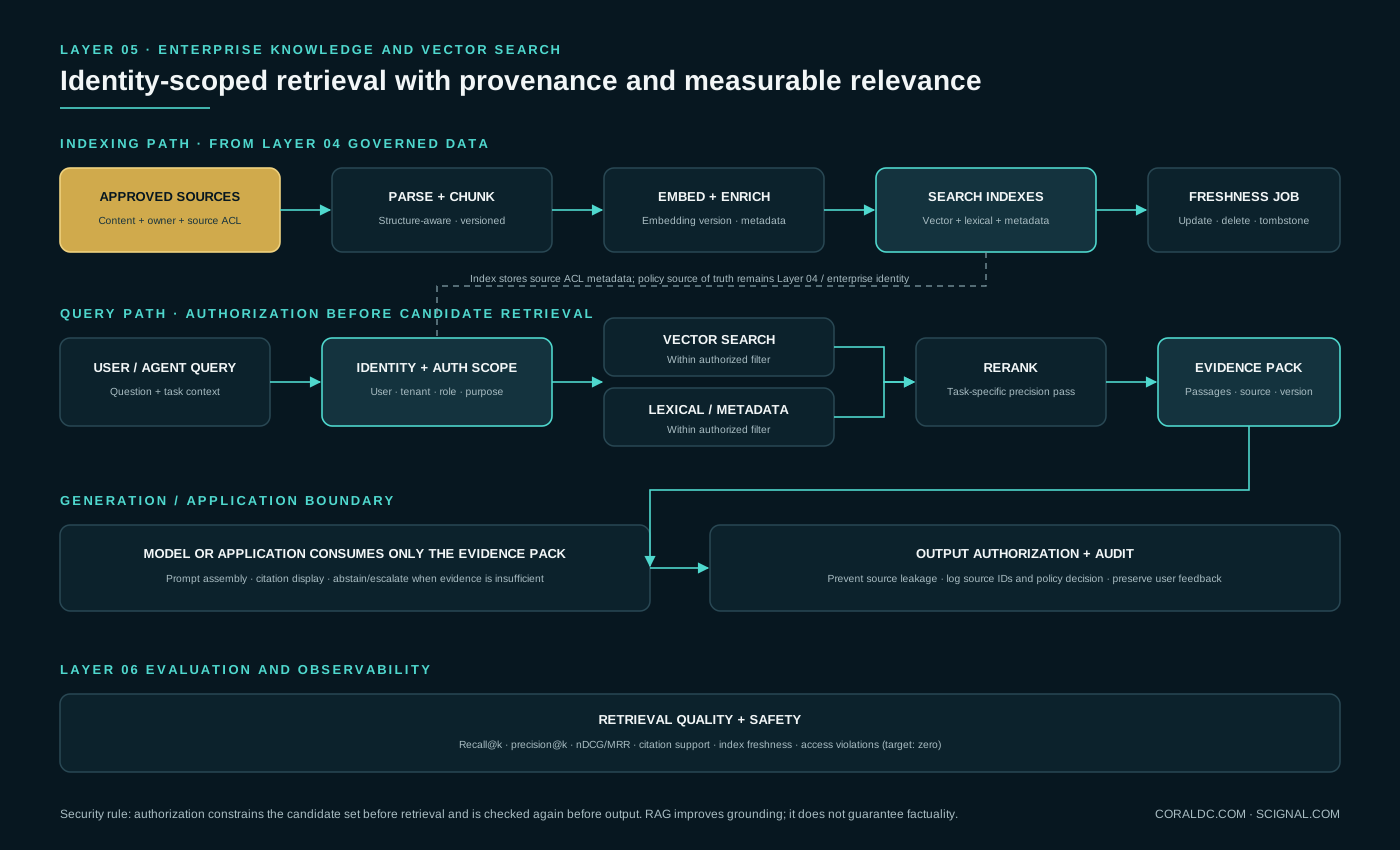
This layer consumes governed, quality-checked data from Layer 04 and serves retrieval results to Layer 07 (AI Platforms), Layer 08 (LLM Engineering, specifically RAG pipelines) and Layer 09 (AI Agents, for knowledge-grounded tool use). Its access-control model must be a direct extension of Layer 04's, not a parallel, independently maintained permission system that drifts out of sync.
Capability model
Embedding generation and management; vector indexing and approximate nearest-neighbour search; hybrid retrieval (combining vector similarity with keyword/metadata filtering); reranking; knowledge graph integration for structured relationship retrieval; access-controlled, permission-aware retrieval; index freshness and update pipelines.
Representative technology stack and selection principles
Milvus is a purpose-built, open-source vector database designed for large-scale, high-performance similarity search, well suited to enterprises with substantial engineering resources wanting full control and self-hosting. Pinecone is a managed vector database service, favoring speed to production and reduced operational burden, at the cost of self-hosting control that sovereignty-constrained deployments may require. Weaviate combines vector search with a native object/graph data model and hybrid search capability, useful where retrieval needs to combine semantic similarity with structured filtering in one system. Qdrant is a performance-focused, open-source vector database with strong filtering capability, often selected for latency-sensitive, self-hosted deployments. pgvector extends PostgreSQL with vector search capability, the pragmatic choice for organizations that want to avoid operating a separate specialized database and can accept its scale and performance ceiling relative to purpose-built vector engines. The selection criterion is rarely raw benchmark performance in isolation; it is self-hosting requirement (driven directly by Layer 01 sovereignty commitments), existing data platform investment (pgvector is compelling specifically where Postgres is already the system of record), and query pattern (pure semantic search versus hybrid search requiring structured filtering and, increasingly, multitenancy-aware isolation between customers or business units sharing one index).1
Selection trade-offs
Managed (Pinecone) versus self-hosted (Milvus, Qdrant, Weaviate, pgvector) is, again, largely a sovereignty and control decision before it is a performance decision. Purpose-built vector engines versus a vector extension to an existing database (pgvector) trades peak performance and feature depth against operational simplicity and reduced system count. Pure vector similarity versus hybrid retrieval (vector plus keyword and metadata filtering, often with a reranking step) trades implementation simplicity against retrieval precision, and hybrid retrieval with reranking is now the practical baseline for enterprise-grade RAG rather than an advanced optimization.
Security, governance and operability requirements
Access-controlled retrieval that enforces the same permission model as the source data, evaluated per query, not per index build; encryption of embeddings and metadata at rest and in transit; audit logging of what was retrieved for which query, sufficient to reconstruct why a model produced a given answer; index freshness monitoring so retrieval does not silently serve stale content after a source document changes or is deleted; and retrieval quality evaluation (precision/recall against a labeled test set) as an ongoing operating discipline, not a one-time acceptance test.
Delivery method and lifecycle
Discover (knowledge sources, access-control requirements, query patterns); architect (vector database selection, hybrid retrieval and reranking design, access-control integration); prototype (retrieval quality validated against representative queries and a labeled evaluation set); industrialize (index update pipelines, monitoring, access-control testing); deploy; govern (ongoing access and content review); operate (index freshness, performance); optimize (retrieval quality tuning based on production query analysis).
Industry applications
Financial services and government use cases frequently require the strictest access-controlled retrieval, since document sets often mix public, internal and highly restricted material within the same corpus. Healthcare and life sciences retrieval systems must respect patient-data and research-data access boundaries with particular care. Universities and research institutions often benefit most from knowledge-graph-augmented retrieval, where relationships between entities (researchers, grants, publications) matter as much as document similarity.
Measurable outcome categories
Retrieval precision and recall against a labeled evaluation set; access-control violation rate (target: zero, continuously tested); index freshness lag; end-to-end grounded-answer accuracy as measured by the evaluation framework at Layer 08.
Common failure modes and anti-patterns
Building a vector index without carrying forward the source system's access controls; treating retrieval quality as solved once a demo works well on a handful of hand-picked queries; choosing a vector database purely on a marketing benchmark without testing against the organization's actual query and content patterns; and neglecting index freshness, so a retrieval system continues surfacing documents that have since been corrected, deleted or reclassified.
Why CoralDC/Scignal
Scignal designs retrieval architecture as a direct, tested extension of the access controls and quality discipline established at Layer 04, on infrastructure CoralDC provisions to keep sensitive indices inside the required sovereignty boundary.
Frequently asked questions
What is the difference between a vector database and a traditional search index?
A vector database retrieves by semantic similarity (meaning) rather than exact keyword match, which is what lets a model find relevant content even when the query and the document use different words for the same concept; most production systems combine both approaches.
How do we stop a retrieval system from leaking documents a user shouldn't see?
By enforcing the source system's access controls at query time within the vector database itself, tested explicitly as part of acceptance criteria, rather than assuming embedding-time filtering is sufficient.
Can pgvector really compete with a purpose-built vector database?
For moderate scale and where Postgres is already the system of record, yes; at very large scale or where advanced filtering and performance are critical, a purpose-built engine such as Milvus or Qdrant is generally the stronger choice. The right answer depends on scale, query pattern and existing infrastructure.
What is reranking, and do we need it?
Reranking applies a second, more precise relevance model to an initial set of retrieved candidates, improving final result quality; it is recommended for most enterprise RAG deployments where answer accuracy matters more than raw retrieval speed.
How often does the index need to be refreshed?
This depends entirely on how quickly the underlying knowledge changes and how costly a stale answer is; freshness requirements are defined during architecture, not assumed.
Does vector search replace our existing enterprise search tool?
Not necessarily; many organizations run vector search as a complement to, or a component within, an existing enterprise search platform, particularly where hybrid retrieval combining keyword and semantic search performs better than either alone.
Sources cited on this page
- 1Qdrant Documentation, "Hybrid Queries" and "Multitenancy.". https://qdrant.tech/documentation/search/hybrid-queries/
Bring this layer into a working architecture.
A Turnkey AI Briefing is a scoped technical conversation about your own stack, not a generic sales call.