
Model Serving and Inference: turning a trained model into a production service
A model that works in a notebook is not a product. Model serving is the layer that makes it callable, fast, cost-controlled and available at the volume the business needs, and the choice of serving architecture is now a real engineering decision with credible, materially different options.
Executive narrative
The gap between "the model works" and "the model is in production" is almost entirely a model-serving problem: batching requests efficiently, managing GPU memory under load, scaling capacity to demand without over-provisioning, and doing all of this with cost and latency characteristics the business case actually requires. Enterprises that skip a deliberate serving architecture decision typically default to whatever the model vendor's SDK does out of the box, which is rarely tuned for production throughput, multi-model hosting or cost efficiency at scale.
Current enterprise problem
Inference cost, not training cost, is now the dominant ongoing AI expense for enterprises running models in production, because inference happens continuously against live traffic while training is a one-time or periodic event. Naive serving deployments waste GPU memory through poor batching, over-provision capacity for peak load that rarely occurs, or under-provision and create latency that breaks user-facing applications. Enterprises also frequently need to serve several models, sometimes several model families and sizes, side by side, and a serving architecture built for a single model rarely handles that cleanly.
Architectural role
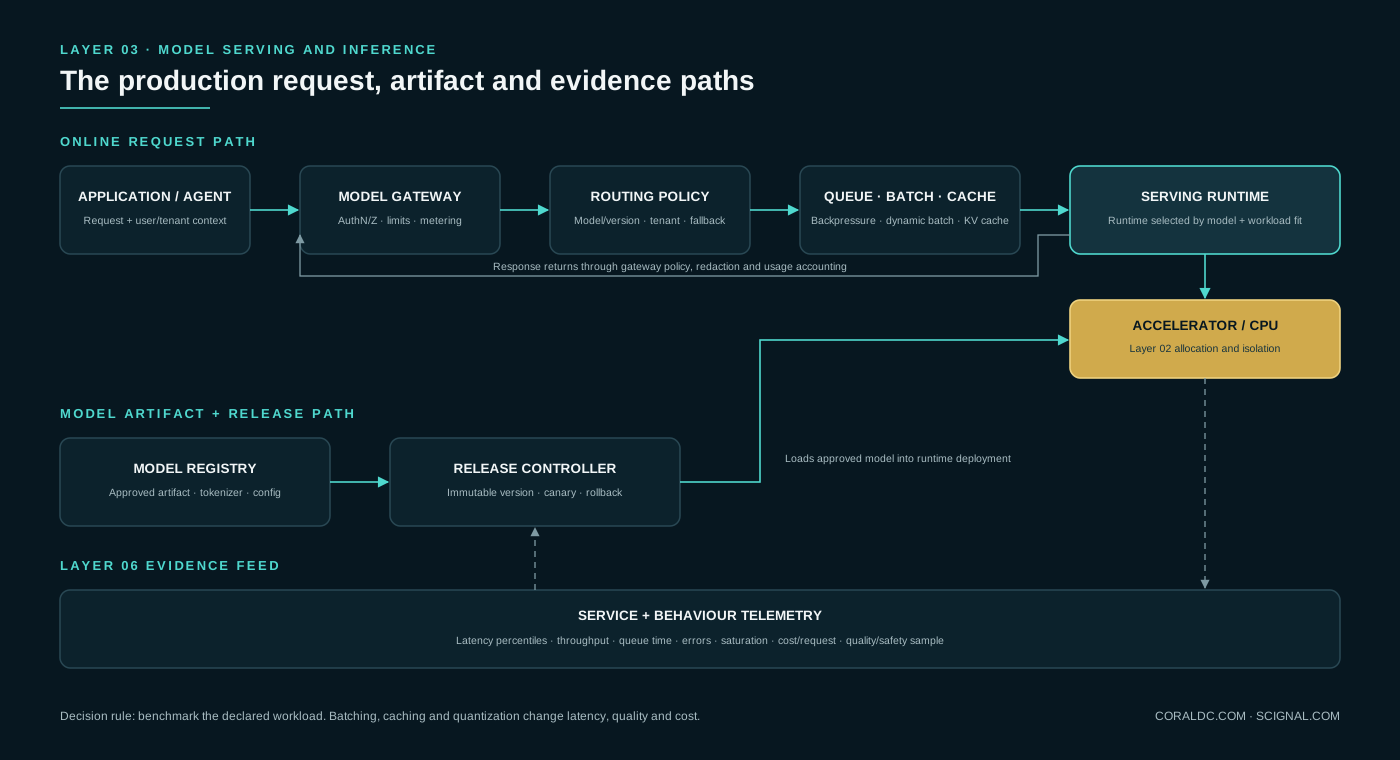
This layer sits directly above Layer 02 (Cloud-Native Infrastructure), which schedules and resources it, and directly beneath Layer 07 (AI Platforms) and Layer 08 (LLM Engineering), which call it. It is also the layer most directly shaped by Layer 06 (MLOps/LLMOps) observability requirements, since serving-layer metrics (latency, throughput, error rate, cost per request) are the primary signal that production monitoring depends on.
Capability model
Model packaging and versioning; request batching and queuing; autoscaling to demand; multi-model and multi-framework hosting; quantization and memory optimization; caching (prompt/response and key-value cache reuse); hardware-aware optimization (tensor parallelism, kernel-level optimization); gateway and routing (model selection, fallback, rate limiting).
Representative technology stack and selection principles
NVIDIA NIM offers pre-optimized, managed microservices for common model families, favoring speed to production and strong alignment with NVIDIA hardware, at the cost of some flexibility for custom or less-common models. Triton Inference Server is a mature, multi-framework, multi-model serving platform with strong Kubernetes integration, well suited to organizations serving a heterogeneous mix of model types (not only LLMs) from one platform.12 vLLM is a leading open-source, LLM-specific serving engine built around PagedAttention for efficient GPU memory use under high concurrency, favored where throughput-per-dollar on open or self-hosted LLMs is the priority.34 Ray Serve is a Python-native, framework-agnostic serving layer well suited to composite, multi-step or agentic inference pipelines that mix models, business logic and external calls, rather than single-model endpoints.56 The selection is rarely "which is best" in the abstract; it depends on hardware commitment (NIM and Triton have particularly strong NVIDIA alignment), workload shape (single large LLM versus many heterogeneous models versus composite agentic pipelines), and internal operational maturity (a managed microservice reduces operational burden; a self-tuned open-source engine maximizes control and cost efficiency for teams with the expertise to run it).
Selection trade-offs
Managed/optimized (NIM) versus open-source/self-tuned (vLLM, Triton) trades speed-to-production and vendor support against flexibility and long-run cost control. Single-framework specialization (vLLM for LLMs) versus multi-framework generality (Triton) trades peak efficiency for a narrow workload against operational simplicity for a broad one. Public API consumption versus self-hosted serving is a privacy and cost decision as much as a technical one: self-hosting is generally required wherever Layer 01 sovereignty commitments preclude sending data to a third-party inference API.
Security, governance and operability requirements
Request-level authentication and authorization at the gateway; rate limiting and quota enforcement per consumer; encrypted transport and, where required, encryption of cached prompts/responses at rest; full request/response logging sufficient for audit and evaluation, subject to data-retention policy; cost attribution per model, team or workload; and integration with Layer 06 observability for latency, error rate, drift and safety-relevant output monitoring.
Delivery method and lifecycle
Discover (model inventory, traffic patterns, latency and cost targets); architect (serving engine selection, batching and autoscaling policy, gateway design); prototype (load-tested against representative traffic); industrialize (CI/CD for model versions, canary and rollback capability, monitoring wired in); deploy; govern (access and cost policy review); operate (capacity management, incident response); optimize (quantization, caching and batching tuning against real traffic data).
Industry applications
Financial services fraud-detection and underwriting models require low-latency, high-availability serving with full audit logging. Healthcare and life sciences deployments frequently require fully self-hosted, on-premises or private-cloud serving to satisfy data-handling requirements that preclude public inference APIs. Telecommunications and manufacturing computer-vision workloads at the edge require lightweight, resilient serving topologies coordinated with a central model registry.
Measurable outcome categories
Latency (p50/p95/p99) against target service levels; cost per inference or per workflow; GPU utilization under production load; model version rollout and rollback time; incident rate attributable to serving-layer failures.
Common failure modes and anti-patterns
Serving every model through a single, unbatched, unoptimized endpoint regardless of traffic shape; choosing a serving engine based on hype rather than hardware alignment and workload fit; omitting cost attribution, which makes runaway inference spend invisible until the invoice arrives; and serving high-risk, regulated inference through a public third-party API when the data-handling requirement calls for self-hosted, sovereign infrastructure.
Why CoralDC/Scignal
Scignal designs and operates the serving architecture against the specific model mix, traffic pattern and cost target of the engagement, on infrastructure CoralDC provisions to match the workload's sovereignty and latency requirement, rather than defaulting to a single serving engine regardless of fit.
Frequently asked questions
Is NVIDIA NIM required if we already use NVIDIA GPUs?
No; NIM is one credible path among several for NVIDIA-based infrastructure, chosen for speed to production on supported model families, but Triton and vLLM also run efficiently on NVIDIA hardware and may be preferable depending on workload shape.
Can we serve open-source and proprietary models from the same platform?
Yes, this is one of the specific reasons a multi-framework platform such as Triton, or a gateway layer in front of several serving engines, is often the right architecture for organizations running a mixed model portfolio.
How is inference cost controlled?
Through batching, caching, quantization, autoscaling matched to real demand, and cost attribution per workload, all of which are architecture decisions made during design rather than settings tuned after a large invoice arrives.
Does self-hosted serving mean we cannot use the latest frontier models?
Some frontier models are only available through vendor-hosted APIs; where that is acceptable under the workload's data-handling requirement, a hybrid architecture (self-hosted for sensitive workloads, API-based for others) is common and is assessed case by case.
What happens if a model version regresses in production?
A properly designed serving pipeline supports canary rollout and fast rollback to the prior model version, gated by the evaluation criteria defined at Layer 06 and Layer 08.
How does this layer support agentic workloads at Layer 09?
Composite serving frameworks such as Ray Serve are specifically suited to multi-step, multi-model agentic pipelines, where a single request may call several models and tools in sequence rather than one model in isolation.
Sources cited on this page
- 1"AI Model Serving on K8s: vLLM vs Triton vs NIM (2026)." Luca Berton, 2026. https://lucaberton.com/blog/ai-model-serving-kubernetes-vllm-triton-nim-2026/
- 2NVIDIA, "Triton Inference Server User Guide.". https://docs.nvidia.com/deeplearning/triton-inference-server/user-guide/docs/index.html
- 3vLLM project discussion, "How does this compare to Triton Inference Server?" vllm-project/vllm, GitHub. https://github.com/vllm-project/vllm/discussions/403
- 4vLLM Documentation. https://docs.vllm.ai/en/latest/
- 5"GPU Inference Servers Comparison: Triton vs TGI vs vLLM vs Ollama." Nicholas Iradler, 2026. https://blog.niradler.com/gpu-inference-servers-comparison-triton-vs-tgi-vs-vllm-vs-ollama
- 6Ray Documentation, "Ray Serve: Scalable and Programmable Serving.". https://docs.ray.io/en/latest/serve/index.html
Bring this layer into a working architecture.
A Turnkey AI Briefing is a scoped technical conversation about your own stack, not a generic sales call.