
LLM Engineering and Evaluation: the craft that makes a capable model reliably correct
A frontier model is a capability, not a solution. LLM engineering, prompting discipline, retrieval-augmented generation, fine-tuning and evaluation, is the applied craft that turns that capability into a system reliably correct for one organization's specific problem, and evaluation is what proves it, rather than asserts it.
Executive narrative
The gap between a model's benchmark performance and its reliability on a specific enterprise task is usually not a model-capability problem; it is an engineering problem, insufficient grounding (RAG), imprecise instruction (prompting), a mismatch between the model's general training and the organization's specific domain and terminology (fine-tuning), and no rigorous way to measure whether any of the above actually improved the outcome (evaluation). Enterprises that treat prompting as a one-time creative exercise, rather than a maintained, versioned engineering artifact, are the ones whose AI systems degrade quietly as underlying models change.
Current enterprise problem
Many organizations experimented with prompting early, achieved an impressive demo, and never built the evaluation discipline to know whether the system still performs as well six months and several model-version upgrades later. Fine-tuning is frequently reached for prematurely, as a first resort rather than a considered choice against RAG, adding cost and maintenance burden without necessarily solving the actual accuracy problem.
Architectural role
This layer sits above Layer 07 (which supplies the orchestration substrate) and Layer 05 (which supplies retrieval for RAG-based approaches), and feeds directly into Layer 09 (an agent's reliability depends entirely on the LLM engineering and evaluation discipline behind its underlying reasoning steps) and Layer 10 (the application layer inherits whatever accuracy and reliability this layer establishes).
Capability model
Prompt engineering and prompt version management; retrieval-augmented generation design (grounding strategy, context construction); fine-tuning and domain adaptation (full fine-tuning, parameter-efficient methods, distillation to smaller models); multimodal system design where relevant; evaluation framework design (automated and human-in-the-loop); red-teaming and adversarial testing; cost and latency optimization at the technique level.
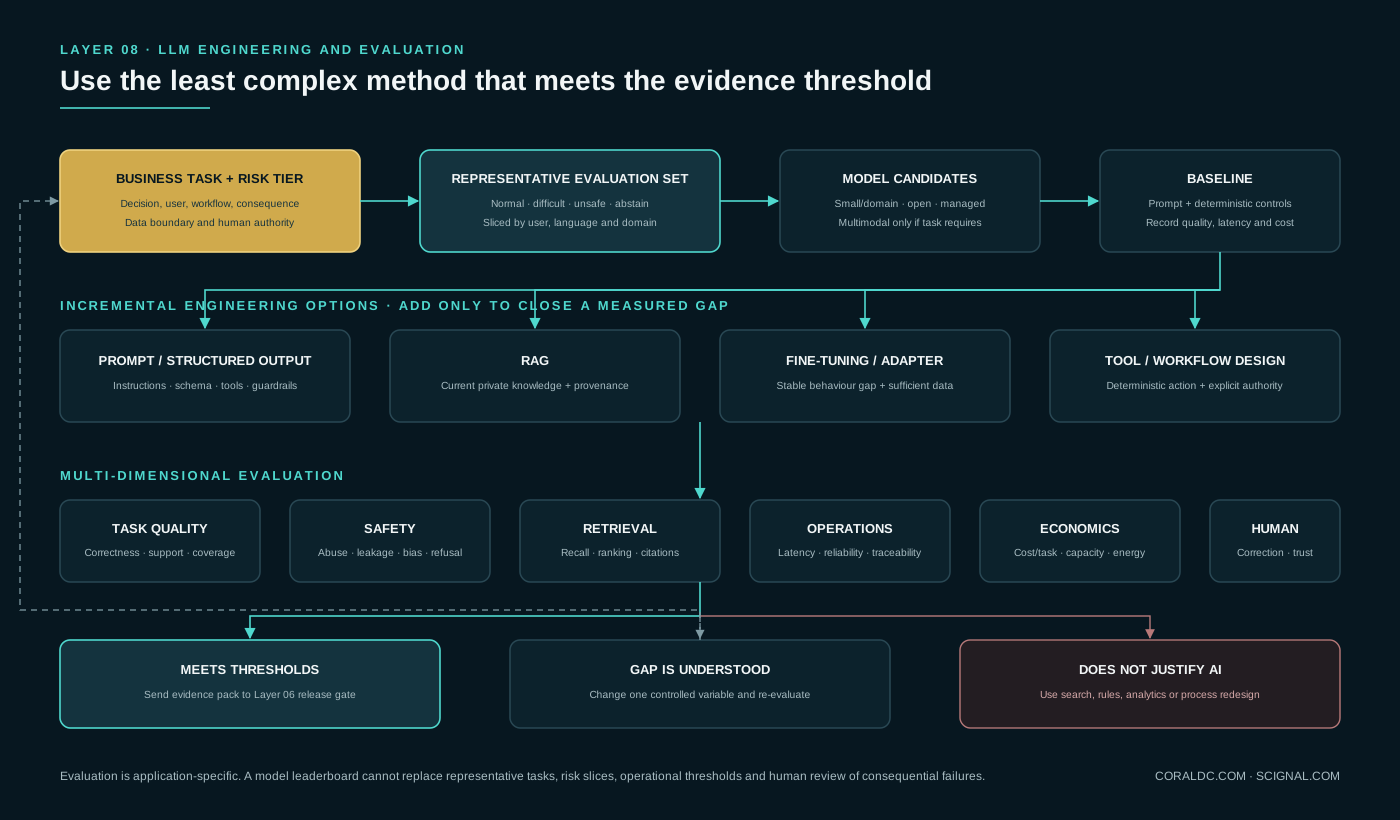
Representative technology and methodology stack with selection principles
Prompting discipline, treated as versioned, tested engineering artifacts rather than informal text, remains the first and lowest-cost lever and should be exhausted, or clearly shown to be insufficient, before more expensive techniques are pursued. Retrieval-augmented generation grounds model output in the organization's actual, current data (built on Layer 05) and is the right default for most enterprise knowledge-intensive use cases, because it keeps the underlying model general and swappable while keeping answers current without retraining. Fine-tuning, whether full fine-tuning or parameter-efficient methods, is the right tool specifically when the problem is stylistic or behavioural adaptation, domain-specific terminology, or task-specific output format, rather than a knowledge-freshness problem that RAG already solves more cheaply and durably. Small and domain-specific models, sometimes reached via distillation from a larger model, are an increasingly credible choice where latency, cost or on-premises/edge deployment constraints outweigh the benefit of a larger general-purpose model, particularly relevant for Layer 01 edge deployments. Evaluation combines automated metrics (groundedness, factual consistency, task-specific accuracy against a labeled test set) with structured human review for dimensions automated metrics cannot yet reliably judge, and should be built as a continuous, versioned discipline, not a one-time pre-launch checklist.
Selection trade-offs
RAG versus fine-tuning is the central trade-off at this layer: RAG is generally cheaper to maintain, keeps knowledge current without retraining, and preserves the ability to swap the underlying model, while fine-tuning is appropriate for behavioural or stylistic adaptation that retrieval cannot address and carries an ongoing retraining and evaluation burden as underlying models change. Large general-purpose models versus small, domain-specific or distilled models trade peak general capability against cost, latency and deployability at the edge, a decision directly connected to the Layer 01 deployment target. Public frontier-model APIs versus self-hosted, fine-tuned or open-weight models is again substantially a sovereignty and data-handling decision, not only a capability decision.
Security, governance and operability requirements
Prompt and configuration version control with rollback capability; evaluation datasets and results treated as governed artifacts, versioned and auditable, feeding the registry and tracking tooling at Layer 06; red-teaming and adversarial testing for safety-relevant use cases before production release; and clear documentation of what data, if any, was used for fine-tuning, subject to the same access-control and consent requirements as the source data at Layer 04.
Delivery method and lifecycle
Discover (target task, accuracy requirement, existing baseline if any); architect (technique selection, RAG versus fine-tuning versus hybrid, evaluation framework design); prototype (validated against a labeled evaluation set, not anecdotal review); industrialize (prompt/version management, evaluation automated and wired into the release gate); deploy; govern (evaluation criteria and red-teaming review); operate (continuous evaluation against production data); optimize (technique refinement as production data accumulates and underlying models evolve).
Industry applications
Financial services underwriting and claims narrative generation typically combine RAG (for policy and case grounding) with strict evaluation for factual accuracy. Healthcare clinical-documentation and life sciences literature-review use cases require rigorous groundedness evaluation and, frequently, domain-specific fine-tuning or distillation for terminology accuracy. Manufacturing and energy operators deploying models at the edge often favor small, distilled, domain-specific models for latency and deployability reasons.
Measurable outcome categories
Task-specific accuracy against a labeled evaluation set; groundedness/hallucination rate; evaluation coverage (percentage of production use cases with an active, versioned evaluation set); cost and latency per technique choice, tracked against the business case that justified it.
Common failure modes and anti-patterns
Reaching for fine-tuning before establishing that RAG and prompting are insufficient; shipping a system validated only against a small, hand-picked set of demo queries rather than a representative, labeled evaluation set; treating a prompt as a one-time creative artifact rather than a versioned, tested engineering asset that must be re-validated when the underlying model changes; and skipping red-teaming for use cases with real safety, legal or reputational exposure.
Why CoralDC/Scignal
Scignal builds evaluation into every LLM engineering engagement from the start, choosing RAG, fine-tuning, distillation or a hybrid based on the specific accuracy, cost and deployment requirement of the use case, rather than defaulting to the most fashionable technique.
Frequently asked questions
Should we fine-tune our own model or use RAG?
For most enterprise knowledge-intensive use cases, RAG should be the default, because it keeps answers current without retraining and preserves flexibility to change the underlying model; fine-tuning is the right choice specifically for behavioural, stylistic or terminology adaptation that retrieval alone does not solve.
How do we know if our AI system is actually accurate, not just convincing?
Through a versioned, labeled evaluation set and a defined evaluation framework, run continuously against production behaviour, not through informal review of a handful of example outputs.
What is red-teaming, and does every use case need it?
Red-teaming is structured adversarial testing to find ways a system could produce unsafe, biased or incorrect output; it should be prioritized for use cases with real safety, legal or reputational exposure, and can be scoped more lightly for lower-risk internal tools.
Can small, domain-specific models really compete with large frontier models?
For well-scoped, domain-specific tasks, yes, often with better latency and lower cost, particularly where the task does not require broad general knowledge; the right choice depends on the specific task's breadth and accuracy requirement.
How often do prompts and evaluation sets need to be revisited?
Whenever the underlying model changes, the business requirement changes, or production monitoring (Layer 06) surfaces a drift in behaviour; this should be a scheduled review, not an ad hoc one.
Does this layer require sending our data to a third-party model API?
Not necessarily; self-hosted and open-weight models, served through Layer 03 on CoralDC infrastructure, are available specifically for use cases where data cannot leave a sovereign or private deployment boundary.
Bring this layer into a working architecture.
A Turnkey AI Briefing is a scoped technical conversation about your own stack, not a generic sales call.