
High-density GPU compute for training, inference, simulation, and research.
AI Factories
From Data Centres to Intelligence Production.
The industrial revolution was powered by factories. The digital revolution was powered by data centres. The AI revolution will be powered by AI Factories: purpose-built environments that transform data into models, predictions, simulations, automation, and decisions.
Platform
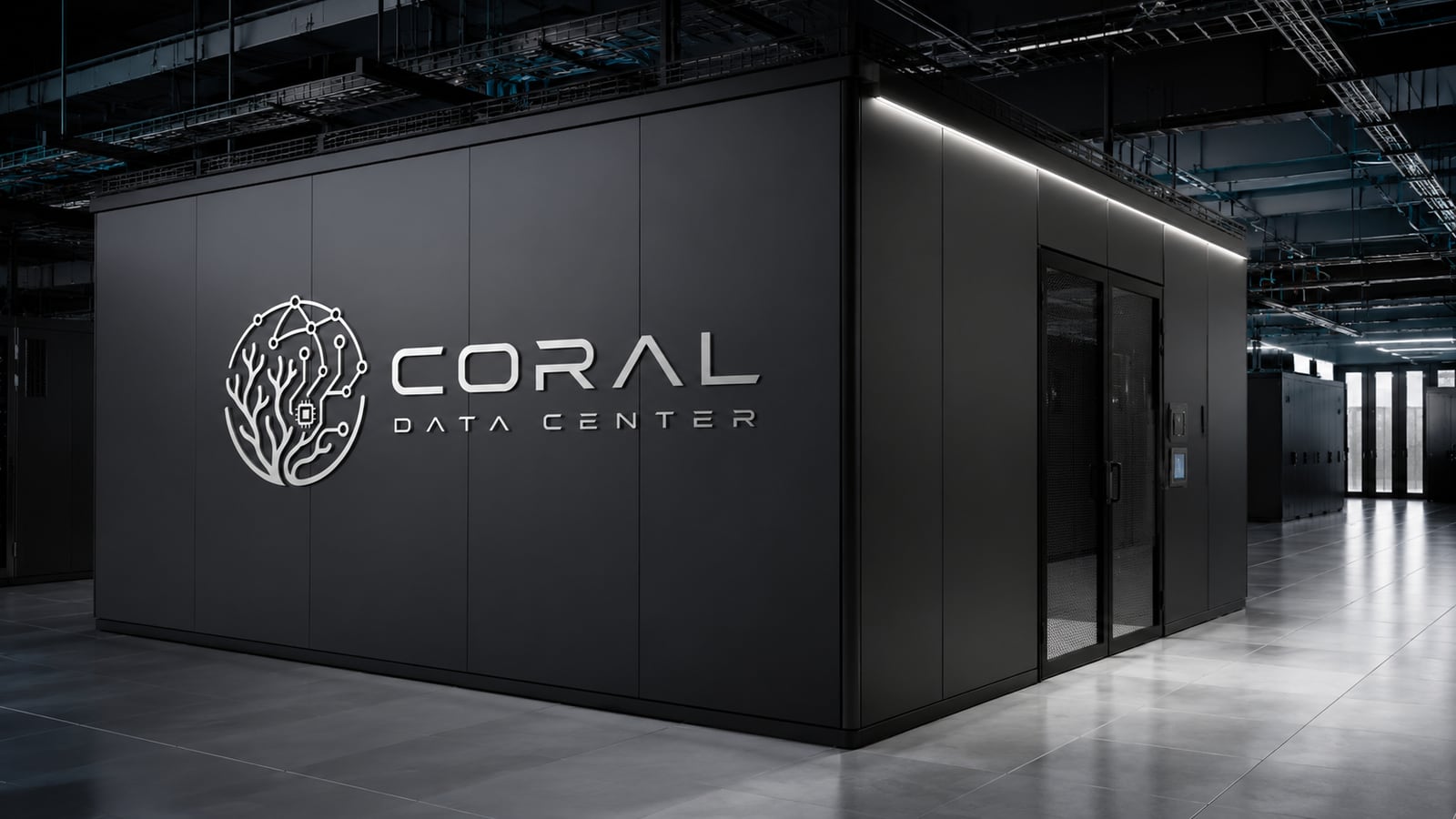
CoralDC AI Factory visual
Own the infrastructure. Govern the intelligence.
FAQ
Direct answers for infrastructure buyers.
What is an AI Factory?
An AI Factory is an integrated compute environment built to train, refine, deploy, and govern AI systems continuously.
How is an AI Factory different from a data centre?
A traditional data centre hosts applications. An AI Factory produces intelligence through accelerated compute, orchestration, data pipelines, model operations, and high-density cooling.
Who needs an AI Factory?
Governments, enterprises, universities, healthcare systems, life sciences firms, manufacturers, banks, utilities, and industrial operators building production-scale AI.
What hardware does Coral OnPrem support?
Coral OnPrem accommodates 19 inch rack and 21 inch OCP form factors, up to 42 by 1U servers, at a maximum IT load of 200 kW. The thermal architecture is selected per deployment to match the customer's hardware rather than requiring the customer to adopt a particular cooling technology.
Who owns and operates the infrastructure?
The customer. Coral OnPrem is deployed on the customer's premises under the customer's control. Operation can be retained in-house or delegated to CoralDC under a managed agreement, and that decision can be reversed later.
How long does deployment take?
Substantially shorter than a conventional build, because the system is self-contained and removes data hall construction from the critical path. For self-contained modular infrastructure of this class, order to production is typically measured in weeks to a small number of months rather than the quarters or years a conventional build requires. A specific timeline for a specific site is produced during the architecture review.
Do Coral systems require a grid upgrade?
Frequently not, which is one of the main practical advantages of pod-scale deployment. A system can often be sized to operate within a building's existing electrical capacity. Whether that is true for a specific site is determined during the architecture review.
Can a Coral deployment run on on-site generation?
Coral systems accept customer-supplied power, including power from on-site generation the customer has arranged. Integrated generation designed and delivered by CoralDC is a research direction, not a current offering.
Coral OnPrem
Who this is built for
Coral OnPrem is high-density private AI infrastructure for organisations that must keep AI workloads under their own control. It installs inside existing premises, supports up to 200 kW of IT load in a 42U immersion pod at a typical PUE of 1.05 to 1.15, and can be operated by the customer or managed by CoralDC.
Health authorities and hospital networks running clinical or research AI under data residency obligations. Universities and research institutes supporting research computing where funder or ethics requirements constrain where data can sit. Government departments and crown corporations. Regulated financial institutions. Industrial operators consolidating AI workloads on their own sites.
Thermal
The thermal architecture today, and what comes next
Coral OnPrem deploys single-phase immersion cooling today, using PAO or synthetic dielectric fluid. CoralDC is engineering a hybrid direct-to-chip-plus-immersion platform as its next generation, for hardware where cold plates are fitted at manufacture. Every Coral OnPrem pod shipping today is single-phase immersion; the architecture selection logic described on the Immersion Cooling page applies to future deployments once the hybrid platform is available, not to a menu of options available now.
Site Requirements
Site requirements
Published prominently, because a buyer who discovers a floor loading problem after signing is a buyer CoralDC loses twice.
| Requirement | Value |
|---|---|
| Rack footprint | 2.57 square metres, plus 0.84 square metres for the pump box |
| Operating weight | Approximately 2,200 kg, against 1,200 kg dry |
| Floor loading | 855 kg per square metre, equivalent to 8.4 kPa, over the rack footprint |
| Structural note | A typical data centre slab is rated 1,000 to 1,500 kg per square metre and accepts this without modification. A typical commercial office floor is rated 250 to 500 kg per square metre and requires structural review. CoralDC states the loading in writing before survey. |
| Recommended ambient | Up to 45 C |
| Operating temperature | Minus 25 C to plus 50 C |
| Relative humidity | 5 to 95 percent, non-condensing |
| Operating altitude | Up to 3,000 metres |
| Facility water | None required in dry rejection configuration |
Power and Grid
Power and grid integration
Coral systems operate on grid power or customer-supplied power. The electrical design question at pod scale is different from campus scale, and increasingly the limiting factor on an AI deployment is not hardware availability or capital, it is the electrical capacity available at the building and the queue to increase it.
For a growing number of institutions the AI project does not stall on procurement. It stalls when facilities establishes that the building's available capacity cannot support the intended density, and that increasing the service means an interconnection process measured in quarters or years. A pod-scale deployment can frequently be sized to fit inside existing capacity where a conventional build cannot. That is a deployment-speed advantage before it is an engineering one.
What CoralDC engineers: the electrical interface between the building and the pod, including distribution, protection and monitoring; power quality and conversion within the pod; and instrumentation of electrical draw at sufficient resolution to be useful to the control layer rather than only to billing.
On-site and behind-the-meter generation, storage integration, and grid-interactive operation are directions CoralDC is researching and seeking partners for. They are not delivered capabilities today and are not sold as such.
Internal Links
Continue through the architecture.
Next Step
Build Your AI Factory
Every CoralDC engagement should connect executive intent, technical architecture, economics, and deployment reality before infrastructure decisions are made.