
Cloud-Native Infrastructure: the operating substrate for AI at scale
Kubernetes, containers and GPU orchestration turn physical accelerator capacity into a schedulable, multi-tenant platform. Get this layer wrong and every layer above it, model serving, data pipelines, agents, inherits its instability; get it right, and the rest of the stack becomes a configuration problem rather than an infrastructure crisis.
Executive narrative
Cloud-native infrastructure is the layer most executives never see and most engineers cannot avoid. It is the difference between a data centre full of GPUs and a platform on which ten teams can safely, predictably run workloads without one team's batch training job starving another's production inference request. For an enterprise moving from pilot to production AI, this layer typically becomes visible only when it fails: a GPU-starved inference service during a demand spike, a noisy-neighbour workload degrading a regulated production system, or a security review that discovers workloads are not properly isolated between tenants or environments. Getting this layer right before it becomes visible is the actual job.
Current enterprise problem
Most organizations arrive at this layer having provisioned GPU capacity, cloud or on-premises, without a scheduling and isolation strategy to match. Kubernetes' default scheduler was not built with GPU-aware bin-packing, fractional GPU sharing or multi-instance GPU (MIG) partitioning in mind, and naive deployments waste expensive accelerator capacity, run workloads with no resource isolation guarantees, or leave teams fighting over the same node pool. The result is a capacity problem that looks like a budget problem, when it is actually an orchestration design problem.
Architectural role
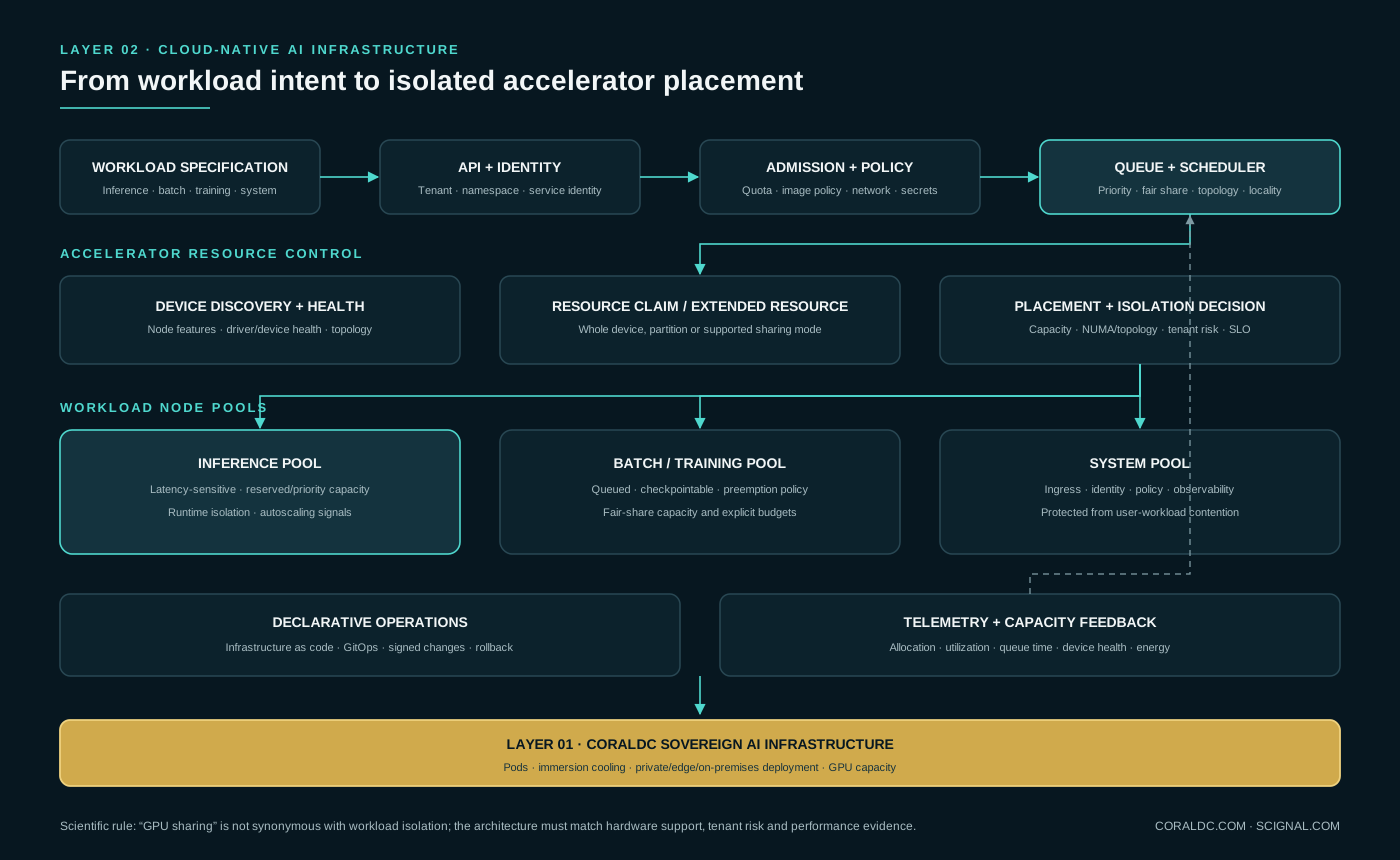
This layer sits directly above Layer 01 (Sovereign AI Infrastructure) and directly beneath Layer 03 (Model Serving). It consumes whatever physical or virtual capacity Layer 01 provisions, whether a CoralDC Pod, an edge deployment or a private AI cloud instance, and exposes it as a schedulable platform with defined tenancy, quota and network policy. Every serving, data engineering and MLOps workload above it depends on this layer's scheduling fairness, isolation guarantees and observability.
Capability model
Container orchestration (workload scheduling, autoscaling, rolling deployment); GPU orchestration (device plugins, MIG/fractional GPU sharing, topology-aware scheduling, workload queueing); multi-tenancy and resource isolation (namespaces, quotas, network policy, node pools); cluster lifecycle management (upgrades, node provisioning, autoscaling groups); infrastructure as code and GitOps (declarative, versioned, auditable infrastructure changes); secrets and policy as code (centralized credential management, admission control, policy enforcement at deploy time).
Representative technology stack and selection principles
Kubernetes is the de facto standard for container orchestration at enterprise scale, and the relevant decision is rarely "Kubernetes or not" but which distribution and GPU operator stack: a managed Kubernetes service reduces operational burden but can constrain sovereignty and customization; a self-managed cluster on CoralDC infrastructure gives full control over scheduling policy, GPU operator configuration and network topology, at the cost of owning cluster operations. Docker and the broader OCI container standard remain the packaging format beneath nearly every workload in this layer, chosen for its portability across the cluster options above. GPU orchestration typically layers a GPU operator (device plugin, driver management, MIG configuration) and a workload-queueing system (for batch/training fairness) on top of the base scheduler; the selection criterion is whether the workload mix is primarily long-running inference services (favoring simpler, latency-focused scheduling) or a mix of batch training and inference (favoring a queueing layer with priority and preemption). GitOps and infrastructure-as-code tooling (declarative manifests, policy-as-code admission controllers) should be treated as non-negotiable for regulated workloads, because they are what make infrastructure changes auditable after the fact.
Selection trade-offs
Managed versus self-managed Kubernetes trades operational convenience against sovereignty and customization depth, directly relevant for customers whose Layer 01 deployment is on-premises or edge, where a managed cloud control plane may not be an option at all. Centralized versus edge cluster topology trades administrative simplicity against latency and resilience, particularly for computer-vision or real-time inference workloads at Layer 10. Portability (standard Kubernetes APIs, avoiding vendor-specific extensions) trades short-term convenience against a durable exit path if infrastructure strategy changes later.
Security, governance and operability requirements
Workload identity and RBAC (role-based access control) scoped to namespace and workload, not just cluster-wide administrator access; network policy enforcing least-privilege communication between workloads; admission control and policy-as-code to prevent unreviewed or non-compliant workloads from deploying; image provenance and software supply-chain verification (signed images, vulnerability scanning) before any workload reaches a production node pool; audit logging of all cluster API activity, retained to match the customer's regulatory requirement; and cluster-level observability (resource utilization, GPU utilization, scheduling latency) feeding the MLOps/LLMOps layer above.
Delivery method and lifecycle
Discover (current infrastructure and workload inventory, tenancy requirements); architect (cluster topology, GPU orchestration policy, network and identity design, matched to the Layer 01 deployment target); prototype (a representative workload validated against the proposed scheduling and isolation model); industrialize (GitOps pipeline, policy-as-code, monitoring wired in before production traffic); deploy; govern (ongoing policy and access review); operate (upgrades, capacity management, incident response); optimize (utilization tuning, cost-per-workload review).
Industry applications
Financial services and government workloads typically require the strongest tenancy and audit guarantees, favoring self-managed clusters on private or sovereign infrastructure with strict policy-as-code enforcement. Manufacturing and energy operators running edge inference (vision inspection, predictive maintenance) require lightweight, resilient cluster topologies at the edge, coordinated with a central control plane. Universities and HPC/research environments often need workload queueing tuned for batch training fairness across many research groups sharing one GPU pool.
Measurable outcome categories
GPU utilization rate; scheduling latency for production inference workloads; number of production incidents attributable to resource contention or misconfiguration; time to provision a new workload environment; audit and policy-compliance pass rate. No specific benchmark figures are published here absent a named, verified engagement.
Common failure modes and anti-patterns
Treating Kubernetes as a default without a GPU-aware scheduling and isolation design; running production inference and best-effort batch training in the same, unprioritized node pool; deploying without policy-as-code and then attempting to retrofit governance after an incident; over-indexing on managed convenience for workloads that legally cannot leave a sovereign or on-premises deployment target. Cloud-native orchestration is not the right layer to solve model-quality or data-quality problems; if a production issue traces back to bad retrieval or a poorly evaluated model, the fix belongs at Layers 04 through 08, not in cluster configuration.
Why CoralDC/Scignal
CoralDC provisions and operates the underlying infrastructure this layer schedules against, sovereign, private, edge or on-premises, so cluster and GPU orchestration design starts from the actual deployment target rather than a generic assumption. Scignal's engineers design and operate the orchestration layer itself, matched to the serving and data workloads it will carry, inside the same accountable engagement.
Frequently asked questions
Do we need Kubernetes if we only run a handful of models?
Not necessarily. A small, stable workload count may be served adequately by a simpler orchestration approach; Kubernetes earns its complexity when tenancy, scale or heterogeneous workload mix demand it. This is assessed during the architecture stage, not assumed by default.
Can this layer run entirely on-premises or at the edge?
Yes; Kubernetes and its GPU orchestration ecosystem run on CoralDC Pods, on-premises deployments and edge sites, which is precisely why this layer and Layer 01 are architected together.
How is GPU sharing handled for smaller workloads that don't need a full accelerator?
Through fractional GPU allocation and multi-instance GPU (MIG) partitioning at the GPU operator level, which lets several smaller inference workloads share one physical accelerator with resource guarantees.
What happens during a cluster upgrade for a production AI workload?
A properly designed cluster uses rolling upgrades and workload disruption budgets so production inference services remain available through node-level maintenance; this is a specific design requirement validated during the architecture stage, not assumed.
Who owns cluster security policy, us or CoralDC/Scignal?
Policy design is a joint decision made with the customer's security and compliance requirements; ongoing enforcement can be operated by CoralDC/Scignal under a Managed AI Operations engagement or retained by the customer's own platform team, depending on the engagement model chosen.
Does this layer lock us into a specific cloud provider?
Standard Kubernetes APIs and OCI-format containers are chosen specifically to avoid this; workload portability across CoralDC's private cloud, on-premises and, where relevant, public cloud targets is a stated design goal, though any managed service's specific extensions should be reviewed for portability before adoption.
Bring this layer into a working architecture.
A Turnkey AI Briefing is a scoped technical conversation about your own stack, not a generic sales call.